
AI agents are moving faster than most technology decisions – and professional services firms in Melbourne are in a different position than general businesses. Accounting practices, law firms, financial advisers, and consultancies face specific regulatory considerations, client confidentiality obligations, and workflow patterns that make AI agent deployment a different conversation. This guide is specifically for Melbourne-based professional services firms deciding where and how AI agents fit.
If you have been following technology news in 2026, you have almost certainly encountered the term “agentic AI” or “AI agents.” The coverage tends to oscillate between enthusiasm about systems that can autonomously complete complex multi-step tasks and scepticism about the gap between what vendors promise and what the technology actually delivers in a real professional services environment. For a business leader in Melbourne or anywhere in Australia trying to make sensible technology decisions, the noise can make it genuinely difficult to assess whether this is something worth understanding now or something that can wait another year.
The honest answer is that AI agents are worth understanding now, not because every professional services firm needs to deploy them immediately, but because the decisions you make about your technology infrastructure and workflows in the next 12 to 18 months will determine how easily you can adopt them when the value case becomes undeniable for your specific context. Understanding what they are, where they currently deliver genuine value for Australian businesses, and where the meaningful limitations remain is a precondition for making those infrastructure decisions well.
What AI Agents Actually Are
The distinction between generative AI and agentic AI is more important than it might initially appear, and getting it clear helps cut through a significant amount of confused or overhyped commentary.
Generative AI in its most common form is a tool that produces an output in response to a prompt. You ask it to draft an email, summarise a document, generate a piece of code, or answer a question, and it produces a single result. The human provides the input, the AI produces the output, and the human then decides what to do with that output. The workflow is fundamentally similar to any other productivity tool: human in, result out, human acts.
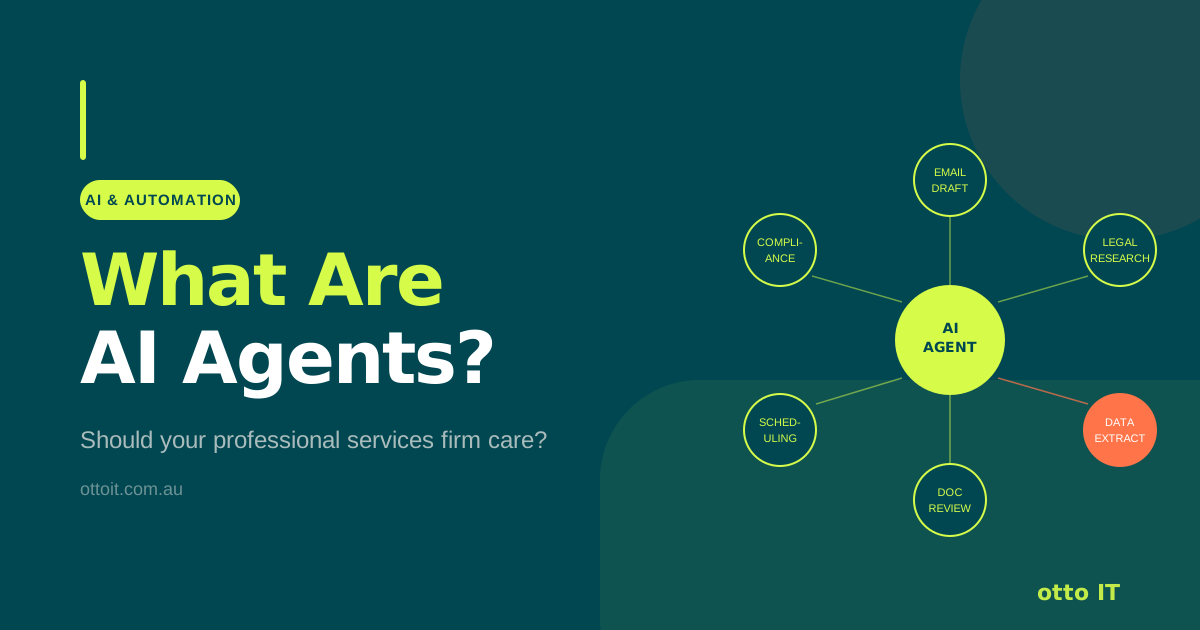
Agentic AI adds two capabilities that change the nature of the interaction materially. First, an AI agent can use tools and take actions, not just produce text. It can search the web, read and write files, execute code, query databases, send emails, fill in forms, and interact with other software systems. Second, an AI agent can pursue a multi-step goal, meaning it can break a goal into sub-tasks, execute them in sequence, evaluate the results of each step, and adjust its approach based on what it finds, before delivering a final outcome.
The practical implication is that an AI agent can be given a goal rather than a specific task. Instead of “draft a summary of this document,” you can instruct it to “gather the publicly available financial information about this company, cross-reference it against our client database, identify any discrepancies, and prepare a briefing note.” The agent handles all the intermediate steps. The human reviews the outcome rather than managing each individual step in the process.
This is not speculative technology in 2026. Agentic AI systems are in active commercial deployment in legal research, financial document processing, client onboarding, compliance monitoring, and a growing range of professional services workflows across Australia and globally. The maturity varies significantly by application, and there are important limitations to understand before deployment, but the technology has moved well past the experimental stage for specific well-defined use cases.
Where AI Agents Deliver Real Value in Professional Services Today
The workflows where AI agents are demonstrating the strongest current value in professional services share a consistent set of characteristics. They are structured, meaning the inputs and expected outputs are well-defined and consistent. They are repetitive, meaning the same process is executed many times across different data. And they are time-consuming relative to the cognitive complexity involved, meaning they consume significant staff time without requiring the level of professional judgement that genuinely benefits from deep human expertise.
Legal research is one of the most developed applications. AI agents can be directed to research a specific legal question, identify relevant cases and legislation, assess their applicability to the specific facts at hand, and produce a structured research memo in a fraction of the time that a junior lawyer would require to complete the same task manually. The output requires senior review, but the time investment at the senior level is for quality assessment and professional judgement rather than the mechanical work of searching, reading, and organising sources across multiple databases.
Contract review and due diligence workflows follow a similar pattern. When a transaction requires reviewing large volumes of documents for specific provisions, obligations, or risk factors, AI agents can process the document set systematically against a defined checklist, flag the items that require human attention, and produce a structured summary that makes the human review process significantly faster and more consistent.
Financial services applications include transaction monitoring, compliance checking against defined regulatory rules, and the preparation of standard reports that draw on multiple data sources. Reducing document processing cycles by up to 75 percent in these workflows represents a structural change in operating costs rather than a marginal efficiency gain, and the evidence base for these outcomes in real-world deployments is now substantial.
For accounting and advisory firms, AI agents are being deployed in workflows where they extract relevant data from client documents, populate working papers, identify anomalies that warrant attention, and flag items that require specific professional assessment, meaningfully reducing the preparatory work that has traditionally consumed significant time from qualified staff whose time is better spent on analysis and advice.
Where the Limitations Still Matter
Being honest about where AI agents do not yet deliver reliable value is as important as being clear about where they do, particularly for professional services firms where errors carry professional liability and reputational consequences that make the cost of mistakes high.
Agentic AI systems can and do make mistakes, particularly when they encounter situations that fall outside the patterns they were designed around or when a task requires the kind of contextual judgement that comes from deep professional experience and relationship knowledge. The errors are not always obvious, which means that reducing human oversight too aggressively before the reliability of a specific deployment is well-established creates meaningful risk. Treating AI agent outputs as requiring verification rather than as a direct replacement for professional review is the appropriate posture for most current deployments.
Tasks that require genuine creative insight, strategic judgement, complex relationship management, or the navigation of ambiguous professional questions are not the right starting point for agentic AI deployment. These are the tasks where experienced professionals add the most distinctive value to clients, and they are also the tasks where AI systems currently perform least reliably. Starting with structured, repetitive, document-heavy workflows and building capability and confidence outward from there is a substantially more sound approach than attempting to automate complex professional judgement in early deployments.
Data security and privacy also require careful attention when deploying AI agents in professional services environments. Agents that can take actions and access multiple systems necessarily have access to sensitive client information, and ensuring that this access is controlled, audited, and compliant with privacy obligations requires deliberate architecture decisions rather than accepting default configurations. This is one of the areas where working with a managed IT provider that understands both AI deployment and security governance is particularly valuable, because the two disciplines intersect in ways that can create vulnerabilities if they are treated as separate concerns.
What Your IT Infrastructure Needs to Support AI Agents
The businesses that will deploy AI agents most effectively in the next two to three years are the ones whose existing technology infrastructure is well-organised, well-integrated, and well-maintained. AI agents work most reliably when the data and systems they interact with are structured and consistent, because the agent’s ability to take effective action depends on its ability to accurately interpret and act on the information it encounters.
An environment where data is scattered across disconnected systems, where document management is inconsistent, where access controls are poorly defined, or where core business systems are not properly maintained creates a poor foundation for AI agent deployment. The agent encounters friction and unpredictability at every step, which both reduces its effectiveness and increases the risk of errors. Conversely, an environment with well-managed cloud infrastructure, clean data governance, and properly integrated business systems provides a substantially stronger foundation for reliable AI deployment.
This means that investing in the quality and organisation of your core IT infrastructure is directly relevant to your AI readiness, not just to your current operational efficiency. The work of improving your managed IT environment has compounding benefits: it makes your business more efficient today and positions you to adopt more sophisticated technology more quickly and reliably as it becomes available.
Otto IT’s managed IT support services and AI, automation and strategic consulting work together to ensure that the infrastructure decisions made today create the right foundation for the AI deployments of tomorrow. We work with professional services firms across healthcare, legal, financial services, and consulting to build technology environments that are secure, well-organised, and positioned to adopt new capabilities as they mature and as the value case becomes clear for specific applications.
Taking the Next Step
If you are a professional services firm leader in Melbourne or elsewhere in Australia trying to decide how to approach AI agents, the most useful question is not “should we deploy AI agents?” but “which specific workflows in our business are the best candidates for AI agent deployment in the next 12 months, and what do we need to have in place to do that well and safely?”
Answering that question requires a clear picture of where your staff spend time on structured, repetitive, document-heavy tasks; an honest assessment of your current IT infrastructure and data organisation; and a view on which AI applications are mature enough to deploy reliably in a professional services context given your specific risk tolerance and client obligations.
The businesses that get the most value from AI agents in the next few years will not necessarily be the earliest adopters. They will be the ones that start with the clearest picture of what they want to achieve, the most disciplined process for validating that tools are delivering it reliably, and the right technical foundation to build on confidently. For professional services firms that have spent the past two years building responsible AI governance, much of that foundation is already in place. The next step is to put it to productive use.
To explore how AI automation could apply to your specific business environment, reach out to our team through the Otto IT contact page.
Frequently Asked Questions
Is Microsoft Copilot the same as an AI agent?
Not exactly. Microsoft Copilot is an AI assistant you interact with through chat or prompts. An AI agent is a more autonomous system that can take actions, run workflows, and complete multi-step tasks without you initiating each step. Copilot Studio allows you to build AI agents on top of the Copilot platform, which is where the two concepts overlap for Microsoft 365 users.
How much does it cost to deploy an AI agent for a professional services firm?
Costs vary significantly. Using Microsoft Copilot Studio with an existing Microsoft 365 licence can range from a few hundred dollars per month in platform fees plus configuration time. Custom-built agents with integrations into practice management or CRM systems will require development investment, which typically starts from $10,000 to $50,000 for a properly scoped build. Ongoing maintenance and iteration are also part of the total cost.
What data does an AI agent access and who controls it?
An AI agent only accesses the data sources you explicitly connect to it. For Microsoft Copilot agents, this is governed by your Microsoft 365 permissions structure, which means the agent respects existing SharePoint and Teams access controls. If a staff member does not have permission to view a document, the agent cannot surface that document to them. You retain full control over what data sources are included.
Are AI agents subject to Australian privacy law obligations?
Yes. If your AI agent processes personal information, it is subject to the Australian Privacy Act 1988 and the Australian Privacy Principles. This includes ensuring data is not transferred overseas without appropriate safeguards, that individuals can access and correct their data, and that you have a clear privacy policy. Professional services firms handling client data should conduct a privacy impact assessment before deploying AI agents that process that data.
Do staff need retraining before we deploy AI agents?
Some orientation is always worthwhile, particularly around understanding what the agent can and cannot do, and how to verify its outputs. Most AI agents are designed to integrate into existing workflows, so the learning curve is lower than a full software rollout. The bigger investment is usually in the configuration and testing phase, not end-user training.
managed it support articles
Related Blog Articles
Discover more insights to optimise your business with the latest IT trends and best practices. Stay ahead of the curve by learning how to leverage cutting-edge technology for success. Explore expert advice and valuable guidance to navigate the evolving world of IT solutions