
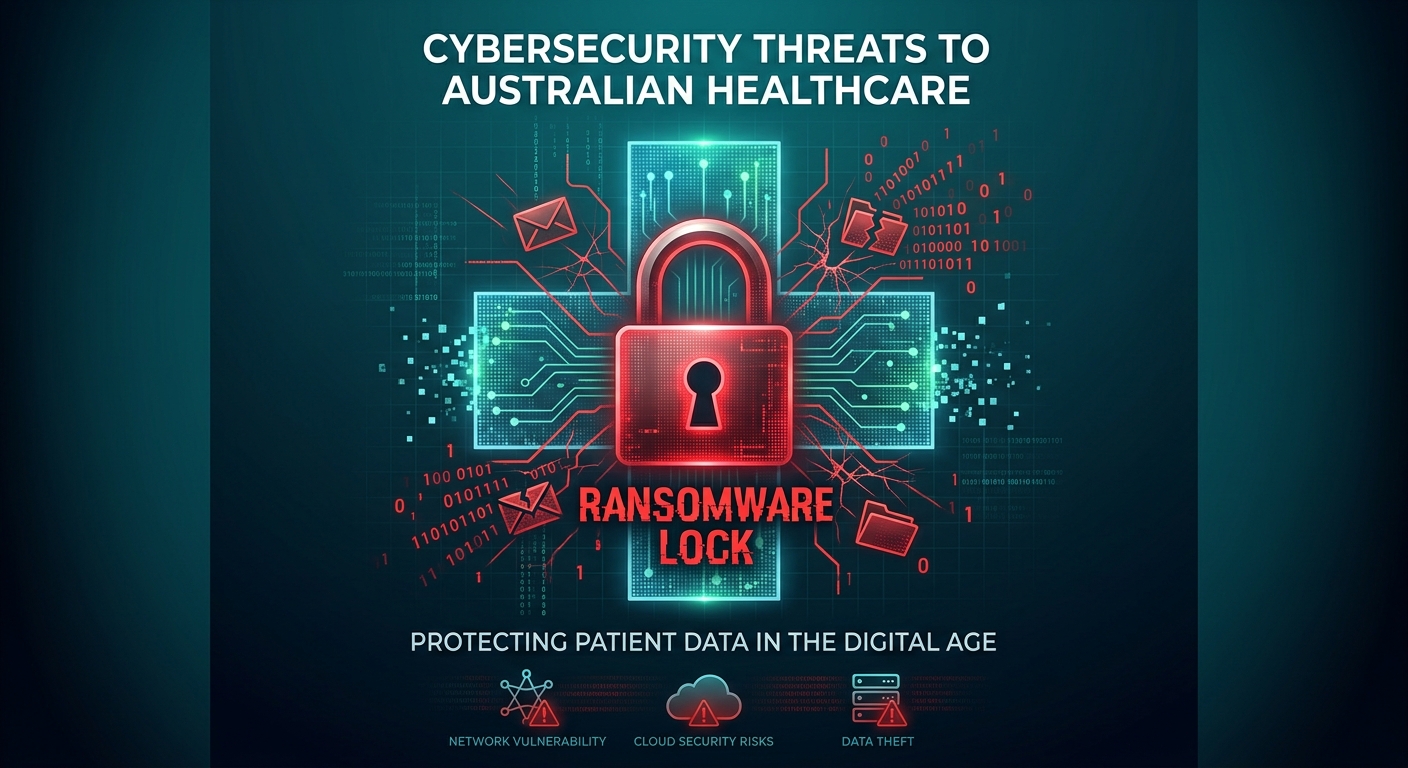
Australian healthcare organisations reported more than 500 data breaches in the first six months of 2025 alone. Each incident affected an average of more than 10,000 individuals. That figure is not a warning about a future threat. It is a description of what is already happening, right now, to medical practices, allied health providers, hospitals, and aged care facilities across the country.
The healthcare sector has become the most-targeted industry for ransomware and data extortion in Australia. Understanding why that is, and what your practice can do about it, is no longer optional.
Why Healthcare Is Ransomware’s Favourite Target
Ransomware groups are businesses, and they choose their victims carefully. Healthcare ticks every box they look for.
The first factor is data value. Medical records contain some of the most sensitive personal information that exists: diagnoses, medications, mental health history, Medicare numbers, and identity documents. This data commands premium prices on dark web markets and gives attackers powerful leverage in extortion negotiations.
The second factor is operational urgency. A law firm that loses access to its files can, in most cases, operate in a degraded state for days while recovery happens. A healthcare practice that loses access to patient records, appointment systems, or prescribing software cannot. When patient safety is at stake, the pressure to pay a ransom quickly and restore access becomes overwhelming. Ransomware operators know this and price their demands accordingly.
The third factor is security posture. Healthcare practices, particularly small and medium-sized clinics, have historically underinvested in cybersecurity. The focus has been on clinical systems and compliance with healthcare-specific regulations, not on the broader IT security controls that protect against modern threats. Many practices run outdated software, have no endpoint detection, and lack a tested incident response plan.
What Australian Healthcare Breaches Look Like in Practice
The pattern of healthcare breaches in Australia follows a predictable sequence. An attacker gains initial access, most commonly through a phishing email, an unpatched vulnerability, or compromised credentials. Once inside, they move laterally through the network, escalating privileges and identifying valuable data. The ransomware payload is then deployed, encrypting critical systems and exfiltrating data simultaneously. The victim receives a ransom demand. If they do not pay, the stolen data is published on a dark web leak site, triggering mandatory notification obligations under the Notifiable Data Breaches scheme.
For healthcare practices, this means patient records, staff information, and billing data can end up publicly accessible, with no way to put that information back in the bottle.
Your Legal Obligations After a Healthcare Data Breach
Healthcare providers in Australia are subject to both the Privacy Act 1988 and, in most cases, the My Health Records Act. Under the Notifiable Data Breaches (NDB) scheme, a healthcare organisation that experiences a breach likely to cause serious harm must notify the Office of the Australian Information Commissioner (OAIC) and affected individuals as quickly as possible, and no later than 30 days after becoming aware of the eligible breach.
Serious harm in a healthcare context is broadly interpreted. The loss of medical records, mental health information, or identity documents almost always meets this threshold. Practices that delay notification or fail to notify at all face significant penalties, and the OAIC has demonstrated a willingness to investigate and enforce.
With the Privacy Act small business exemption being removed in December 2026, practices that have previously operated below the $3 million turnover threshold will soon be subject to the full framework of the Privacy Act for the first time. The window to prepare is narrowing.
What Your Practice Should Have in Place Right Now
The good news is that most ransomware attacks against healthcare practices are preventable with the right controls. These do not require a large IT department or an enterprise-level budget. They require the right managed security partner and a commitment to getting the basics right.
The most important controls for healthcare practices are listed below.
Regular, Tested Backups Stored Offline
If ransomware encrypts your systems, an immutable backup stored offline or in an air-gapped environment is the difference between paying a ransom and restoring your own data. Backups stored on the same network as your clinical systems provide no protection against ransomware that can find and encrypt them. Every backup should be tested with a full restore at least quarterly.
Multi-Factor Authentication on All Systems
Compromised credentials are one of the most common initial access vectors in healthcare breaches. Multi-factor authentication on email, remote access, and patient management software adds a layer of protection that stops credential-based attacks even when passwords have been leaked in a previous breach.
Endpoint Detection and Response on Every Device
Traditional antivirus is no longer sufficient against modern ransomware. Endpoint detection and response (EDR) tools provide real-time monitoring, behavioural detection, and automated response capabilities that can stop an attack before it spreads across the network. Every device connected to your clinical environment should have EDR installed and actively monitored.
Staff Training on Phishing and Social Engineering
Healthcare staff are targeted directly, often with convincing emails impersonating suppliers, insurers, or Medicare. Regular awareness training significantly reduces the likelihood of a successful phishing attack landing. Training should be practical and scenario-based, not a once-per-year checkbox exercise.
A Documented Incident Response Plan
Knowing what to do in the first 24 hours of a cyber incident is critical. Who do you call? What systems do you isolate? When do you notify the OAIC? Having these answers written down before an incident happens removes confusion at the worst possible moment. An incident response plan should be reviewed at least annually and tested through a tabletop exercise.
The Role of a Managed Security Partner
Most healthcare practices do not have an in-house IT security team. Nor should they need one. The right managed IT and security partner monitors your environment continuously, applies patches before vulnerabilities are exploited, manages your backups, and provides an incident response capability when something goes wrong.
Our managed cybersecurity services are designed specifically for Australian businesses and professional services organisations, including healthcare practices that need to meet regulatory obligations while keeping their focus on patient care.
If you are not sure whether your current IT setup meets the security standards that healthcare regulators and insurers now expect, get in touch with our team for an honest assessment.
Book a Free Cybersecurity Assessment
Australian healthcare practices face a genuinely elevated threat environment right now. The combination of high-value patient data, operational urgency, and historically underfunded security makes the sector a prime target for ransomware groups that have become increasingly sophisticated and aggressive.
The practices that come through a cyber incident intact are not the ones that got lucky. They are the ones that invested in the right controls before the attack arrived.
Book a Free Cybersecurity Assessment
Frequently Asked Questions
Is my small medical practice really at risk of a ransomware attack?
Yes. Ransomware groups have moved down-market deliberately. Small and medium-sized healthcare practices are often easier targets than large hospitals, with less security investment and the same high-value data. Size is not a protection.
What data is most at risk in a healthcare breach?
Patient medical records, mental health information, Medicare details, prescriptions, identity documents, and staff payroll data are all high-value targets. The combination of sensitive personal health information and identity data makes healthcare records particularly attractive to attackers and extortionists.
Am I legally required to report a cyber incident if I run a healthcare practice?
Yes. Healthcare providers are covered by the Notifiable Data Breaches scheme. A breach likely to cause serious harm must be reported to the OAIC within 30 days. Health information is specifically listed as a category attracting heightened obligations under the Privacy Act 1988.
What is the first thing I should do if I suspect my practice has been compromised?
Isolate the affected systems from the network immediately to prevent the attack from spreading. Do not turn systems off, as this can destroy forensic evidence. Contact your IT provider and, if you believe data has been accessed, engage a cyber incident response specialist as quickly as possible.
How do I know if my backups will actually work in a ransomware scenario?
Backups need to be tested regularly, stored offline or in an immutable format, and held separately from the systems they back up. If you have not tested a full restore in the last 90 days, your backup plan is theoretical rather than operational. A managed IT provider should be testing your backups on your behalf.
What does an EDR solution actually do?
Endpoint detection and response (EDR) monitors every device on your network in real time, looking for behaviours that indicate an attack is underway. Unlike traditional antivirus, which looks for known malware signatures, EDR detects unusual activity patterns even when the malware itself has never been seen before. When a threat is detected, EDR can automatically isolate the affected device before the attack spreads.
managed it support articles
Related Blog Articles
Discover more insights to optimise your business with the latest IT trends and best practices. Stay ahead of the curve by learning how to leverage cutting-edge technology for success. Explore expert advice and valuable guidance to navigate the evolving world of IT solutions