
If you work with larger organisations, government clients, or are involved in procurement processes in Australia, there is a good chance you have come across ISO 27001. It appears on vendor questionnaires, contract requirements, and tender specifications with increasing frequency. But for many small and medium businesses, the question is whether pursuing certification is actually worth it.
This guide explains what ISO 27001 is, what it involves, and how to assess whether your Australian business should pursue it.
What Is ISO 27001?
ISO 27001 is an internationally recognised standard for information security management. It was developed by the International Organisation for Standardisation (ISO) and the International Electrotechnical Commission (IEC). The full title is ISO/IEC 27001.
The standard provides a framework for establishing, implementing, maintaining, and continuously improving an Information Security Management System (ISMS). An ISMS is essentially a documented set of policies, processes, and controls that an organisation puts in place to manage information security risks systematically.
Certification means that an accredited external auditor has assessed your ISMS and confirmed that it meets the requirements of the standard. A certificate is typically valid for three years, with annual surveillance audits to maintain it.
What Does ISO 27001 Involve?
Achieving ISO 27001 certification involves several stages.
Gap Analysis
You start by assessing your current state against the requirements of the standard. This tells you what you already have in place and what you need to build or document.
Risk Assessment
A formal information security risk assessment identifies the threats and vulnerabilities relevant to your business, the potential impact of security incidents, and the controls you should implement to manage those risks.
Implementing Controls
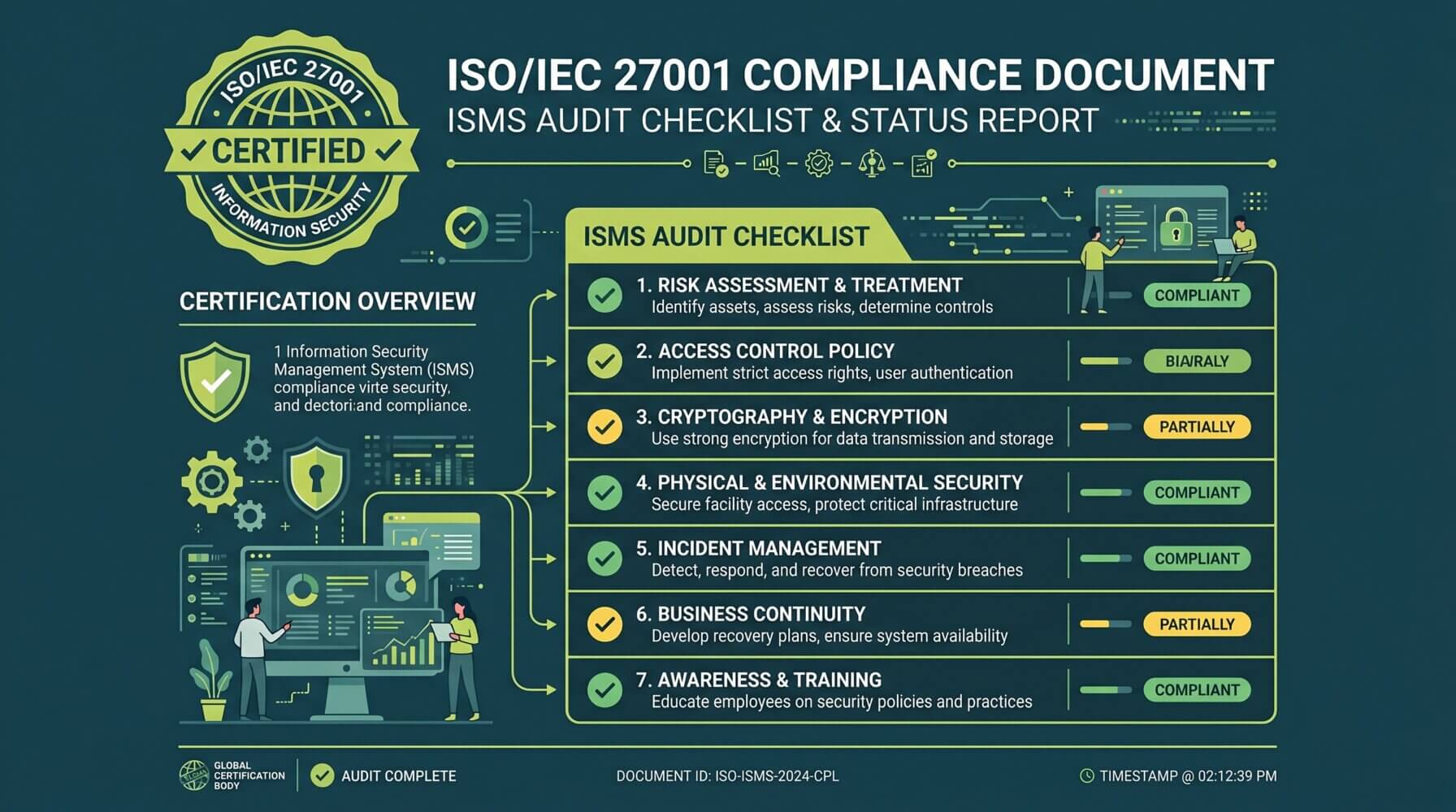
ISO 27001 includes a set of controls (Annex A) covering areas including access control, cryptography, physical security, incident management, supplier relationships, business continuity, and compliance. You are not required to implement every control, but you must document why any excluded control is not applicable to your organisation.
Documentation
ISO 27001 has significant documentation requirements. You need written policies, procedures, risk registers, and evidence of the processes you have implemented. For many businesses, this is the most time-consuming part of the process.
Internal Audit and Management Review
Before pursuing certification, you need to conduct an internal audit of your ISMS and a management review to confirm leadership commitment and identify improvements.
Certification Audit
An accredited certification body conducts a two-stage audit. Stage one is a documentation review, and stage two is an on-site assessment of whether your ISMS is actually operating as documented. If the audit is successful, you receive your certificate.
How Long Does It Take and What Does It Cost?
The timeline depends on the size of your organisation and how mature your existing security practices are. For a small to medium business starting from a low base, twelve to eighteen months is a realistic timeline to achieve certification. Organisations with mature existing practices may achieve it faster.
Costs vary significantly based on your organisation size, the scope of certification, and whether you use external consultants. You will have costs for consulting support, staff time, any technology or process changes required, and the certification audit fees themselves. Budget allocations vary widely and it is worth getting specific quotes based on your scope from a reputable consultant or certification body before committing.
Does Your Australian Business Actually Need ISO 27001?
The honest answer is: it depends on your market and your clients.
ISO 27001 certification is worth pursuing if:
- You tender for government contracts or are on government panels where it is required or advantageous
- Your enterprise clients require vendor certification as part of their supply chain security requirements
- You handle highly sensitive data, such as health records, financial data, or national security information
- You want to differentiate your business on security credentials in a competitive market
- You are planning to expand into international markets where ISO 27001 is a common baseline requirement
ISO 27001 may not be the right priority if:
- Your clients do not currently ask for it and you operate in a market where it is not expected
- You are a very small business where the effort and cost outweigh the market benefit
- Your security fundamentals are not yet in place — there are more immediate priorities to address first
Alternatives and Complements to ISO 27001
For Australian businesses, the Australian Government’s Essential Eight Maturity Model is a practical alternative starting point. It focuses on eight specific mitigation strategies that address the most common cyber threats and is well aligned with the expectations of Australian government and enterprise clients.
The Essential Eight is not a certification standard in the same way as ISO 27001, but demonstrating adherence to it is increasingly expected in Australian government and defence supply chains.
ISO 27001 and the Essential Eight are complementary — implementing one tends to move you closer to the other.
For businesses in healthcare, the Australian Privacy Act and My Health Records Act impose specific requirements around health information that may be more immediately relevant than ISO 27001.
Getting Started
If you are considering ISO 27001 or want to understand where your business currently sits relative to good security practice, a security review or gap analysis is a practical first step. This gives you an objective view of your current state and what would be required to reach certification.
For information on cybersecurity assessments and compliance support for Australian businesses, visit the Otto IT cybersecurity services page. To discuss your specific situation, contact the Otto IT team.
Summary
ISO 27001 is a rigorous and internationally recognised framework for managing information security. It is worth pursuing if your clients or market require it, but it is a significant investment of time and resources. If you are unsure whether certification is the right priority, start with a security review to understand your current state and the practical steps to improve it.
If your business needs help getting the most out of Microsoft 365 or keeping your IT running smoothly, talk to the Otto IT team.
Frequently Asked Questions
How long does ISO 27001 certification take for an Australian SMB?
Most small and medium businesses take 12 to 18 months from initial gap assessment to receiving certification. The timeline depends on how mature your existing security practices are, how quickly you can implement the required controls, and the capacity you have internally to drive the project. Organisations with minimal security documentation and immature processes should expect to be at the longer end of that range. Working with an experienced consultant can significantly accelerate the process.
How much does ISO 27001 certification typically cost for a small Australian business?
Total costs depend on your starting point, but a realistic budget for a small business (under 50 staff) pursuing first-time certification would include consultant fees of $30,000 to $80,000, certification audit fees of $8,000 to $20,000, and ongoing surveillance audit costs of $4,000 to $10,000 per year. There are also internal costs for staff time, control implementation, and tooling. These figures are indicative and vary based on complexity and the specific certification body used.
What is the difference between ISO 27001 and the Australian Essential Eight?
The Essential Eight is a prioritised set of eight technical mitigation strategies published by the Australian Cyber Security Centre, focused specifically on preventing cyber incidents. ISO 27001 is an international standard covering a comprehensive information security management system — including governance, risk management, asset management, physical security, and continuous improvement. Essential Eight compliance is a technical baseline; ISO 27001 is a broader management system framework. The two complement each other rather than compete.
Do I need to recertify ISO 27001 every year?
ISO 27001 certification operates on a three-year cycle. In years one and two (surveillance audits), your certification body conducts lighter-touch audits to verify that your management system is being maintained. In year three, a full recertification audit is conducted. Between audits, your internal audit programme and management reviews are your ongoing assurance mechanism. Letting your programme lapse between audits is the most common reason businesses fail their surveillance audits.
managed it support articles
Related Blog Articles
Discover more insights to optimise your business with the latest IT trends and best practices. Stay ahead of the curve by learning how to leverage cutting-edge technology for success. Explore expert advice and valuable guidance to navigate the evolving world of IT solutions