

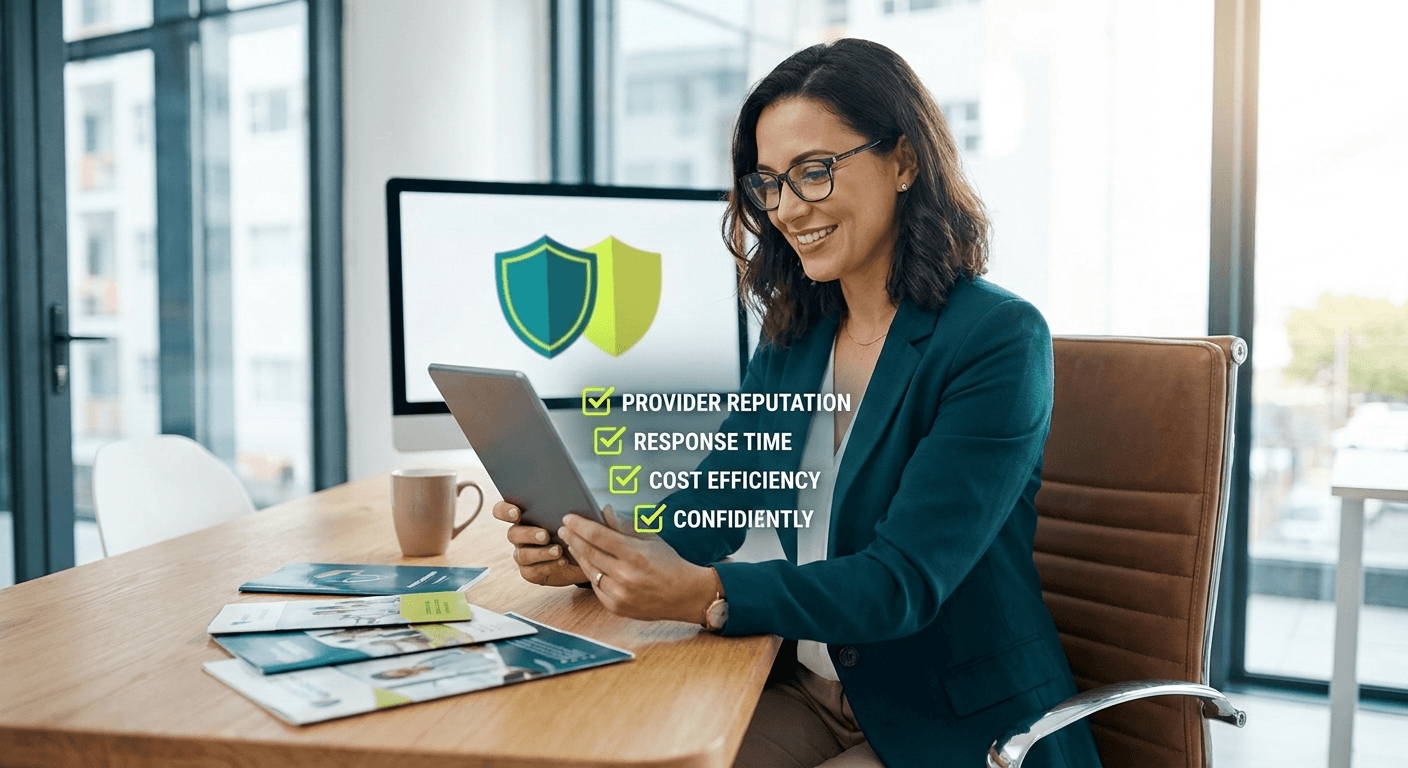
Choosing a cybersecurity provider in Australia is one of the most consequential decisions a business leader can make , and most do it wrong. The real danger is not skipping security altogether. It is paying for security that does not actually work, then assuming you are protected. This post closes out our 12-part cybersecurity series with the one question that matters most: how do you choose a provider you can actually trust?
Why the Wrong Provider Is Worse Than No Provider
A business with no cybersecurity knows it is exposed. A business with bad cybersecurity thinks it is covered. That false sense of security leads to delayed detection, slower response, and far worse outcomes when something goes wrong.
We covered what a cyber attack actually looks like in our first post in this series. The consistent theme across every type of attack is that damage compounds when nobody notices in time. A poor provider gives you the paperwork without the protection. Auditors and insurers may tick the box. Attackers will not be impressed.
This is not about fear. It is about choosing correctly the first time so you do not have to explain a breach to your clients, your board, or the OAIC.
Generalist IT Provider vs Security-Focused MSP: What Is the Difference?
Most Australian businesses already have an IT provider. That provider patches servers, manages devices, and keeps email running. That is not cybersecurity. It is IT operations.
A security-focused managed service provider (MSP) does something different. They monitor for threats actively, not just manage infrastructure reactively. They have a dedicated security team, incident response procedures, and documented escalation paths. They are thinking about what attackers are doing today, not just what broke yesterday.
A generalist IT provider might add security tools to their stack. Antivirus, a firewall, maybe endpoint detection. But tools without expertise behind them are not security. They are technology theatre.
When you are evaluating providers, ask directly: do you have a dedicated security team, or is security handled by your general helpdesk?
What to Look For: Certifications and Real Experience
Certifications are not everything, but they are a starting point. A credible cybersecurity provider in Australia should be able to demonstrate:
Relevant Certifications
- ISO 27001 , the international standard for information security management systems. If a provider holds this, they have been audited against a rigorous framework.
- SOC 2 Type II , particularly relevant if your provider hosts data or runs cloud services on your behalf. Type II means they have been assessed over time, not just at a point in time.
- IRAP (Information Security Registered Assessors Program) , relevant for businesses working with Australian government data or agencies. If this applies to your sector, it matters.
- Essential Eight maturity assessment capability , the Australian Cyber Security Centre’s Essential Eight framework is the baseline for most Australian businesses. Your provider should be able to assess and improve your maturity against it.
Real Experience
Ask how long they have been doing security work specifically, not IT work generally. Ask for examples of incident response situations they have managed. Ask what industries they serve and whether those industries have similar compliance requirements to yours.
A provider who has never handled a real incident under pressure is a very different proposition from one who has managed a ransomware event at 11pm on a Friday and kept a business running.
Response Times and SLAs
Cybersecurity incidents do not happen during business hours on a Tuesday. Your provider’s SLA needs to cover after-hours, weekends, and public holidays with defined response times. “We will get back to you” is not an SLA. “P1 incidents: 15-minute response, 24 hours a day, 7 days a week” is an SLA.
The Questions You Must Ask Before You Sign Anything
Good providers will answer these questions directly. Weak providers will deflect, generalise, or get defensive. Ask every one of them.
“When were you last independently audited?”
If the answer is vague or they cannot name an auditor, that is a red flag. Credible providers are assessed regularly by third parties. They should be able to tell you when, by whom, and what the scope covered.
“What happens if I am breached while under your care?”
This is the most important question you can ask. You want to understand who is responsible for what, what the notification process looks like, whether their insurance covers your losses, and what remediation looks like. If they have never been asked this before, that tells you something.
“How do you handle an incident at 2am on a Sunday?”
Security incidents do not schedule themselves. You need to know whether a real person picks up the phone, what the escalation path is, and how long it takes to get someone with the right expertise engaged. Ask for the actual process, not the marketing answer.
“What is included versus what costs extra?”
Many security providers quote a base managed service fee, then charge separately for incident response, forensics, compliance reporting, and user training. You need to understand what is covered before a breach, and what the bill looks like after one. Get it in writing.
“How do you stay current with emerging threats?”
The threat landscape in Australia changes constantly. Your provider should be subscribed to threat intelligence feeds, participating in industry groups, and tracking advisories from the Australian Cyber Security Centre. If their answer is “we update our antivirus,” find someone else.
Red Flags That Should End the Conversation
Watch for these during your evaluation process:
- Vague answers to specific questions. If you ask for their incident response SLA and they describe a philosophy instead of a number, they do not have one.
- Pressure to sign a long contract immediately. A provider confident in their service does not need to lock you in before you have had time to evaluate them properly.
- No dedicated security team. Security managed by a general helpdesk is not managed security. It is helpdesk with a firewall.
- No clear escalation path. Who gets called when the first responder cannot resolve the issue? If they cannot answer that clearly, there is no path.
- They lead with tools, not outcomes. Providers who spend the sales conversation listing product names are selling technology, not security. Security is what the technology enables, not the technology itself.
- No transparency about subcontractors. Some providers resell other providers’ services without disclosing it. You have a right to know who actually holds your data and responds to your incidents.
The Honest Truth About Cost
Good cybersecurity costs money. A properly staffed, genuinely capable managed security service is not the cheapest line on your IT budget. That is the reality.
It is also far less than a breach. The average cost of a data breach in Australia includes regulatory penalties under the Privacy Act, notification costs, legal fees, remediation work, reputational damage, and lost business. For a professional services firm, the indirect costs , client trust, referral pipeline, team morale , often exceed the direct costs.
The question is not whether you can afford good security. It is whether you can afford to go without it, or to buy the cheap version and discover it does not work when you need it most.
When comparing quotes, do not compare monthly fees alone. Compare what is actually covered, what the response SLA looks like, and what the total cost of ownership is over two to three years including any incident-related costs that fall outside the base agreement.
What a Managed Security Service From Otto IT Looks Like
Our managed cybersecurity service is built for professional services firms that need real security without building an in-house team. Here is what that means in practice:
- 24/7 threat monitoring across your endpoints, network, cloud environments, and identity systems , not just during business hours.
- Essential Eight assessment and ongoing maturity improvement aligned to ACSC guidance, so you have a clear picture of where you stand and how to improve it.
- Defined incident response SLAs with escalation paths that do not rely on a single person being available.
- Transparent reporting , monthly security reviews, clear documentation of what was detected and what was done about it.
- Compliance support for businesses managing obligations under the Privacy Act, industry regulations, or client security requirements.
- Onboarding that starts with your current environment , not a rip-and-replace approach, but a structured improvement plan from where you are today.
We are a security-focused MSP that serves businesses in Melbourne and across Australia. We work with firms that have tried the generalist IT route and found it lacking when they needed it most. Our job is to make sure that does not happen to you.
How Microsoft Copilot Can Help You Evaluate Providers
If you are in the middle of evaluating multiple cybersecurity providers and finding it hard to compare them consistently, Microsoft Copilot can help. You can use it to build a structured vendor evaluation scorecard, standardise the questions you ask each provider, and summarise responses across multiple conversations or documents.
A prompt like “create a cybersecurity vendor evaluation scorecard based on these criteria” will give you a usable framework in minutes. Paste in your shortlisted providers’ responses and ask Copilot to identify gaps or inconsistencies in their answers. It will not make the decision for you, but it will make the comparison cleaner and harder to game with slick sales language.
This is one of the more underrated uses of AI in business , not generating content, but helping you make better procurement decisions with the information you already have.
Ready to Make the Right Call?
This is the final post in our 12-week cybersecurity series. If you have read through the series, you now understand what attacks look like, how to build an incident response plan, and what good security actually requires. The last step is finding a provider who can deliver it.
We offer a no-obligation security assessment for Australian businesses. In that session, we look at your current environment, identify your highest-priority risks, and give you an honest picture of where you stand , with no pressure to sign anything.
Book your security assessment here. It is a conversation, not a sales pitch. Come prepared with the questions from this post and we will answer every one of them.
Frequently Asked Questions
How do I choose a cybersecurity provider in Australia?
Start by confirming they have a dedicated security team, not just an IT helpdesk that handles security as a secondary function. Ask for their incident response SLA, their most recent independent audit, and what happens if you experience a breach while under their care. Look for relevant certifications such as ISO 27001 or IRAP, and make sure their service agreement is transparent about what is included and what costs extra.
What certifications should a cybersecurity provider have in Australia?
ISO 27001 is the most widely recognised information security management certification. SOC 2 Type II is relevant if your provider manages cloud infrastructure or holds data on your behalf. IRAP is important for businesses working with government agencies. Beyond certifications, look for demonstrated capability against the ACSC’s Essential Eight framework, which is the Australian baseline for business cybersecurity.
What is the difference between an IT provider and a cybersecurity MSP?
An IT provider manages your technology infrastructure: servers, devices, email, and helpdesk support. A cybersecurity MSP actively monitors for threats, runs incident detection and response, and maintains a dedicated security team. Many IT providers offer security tools as part of their stack, but tools without the right expertise and processes behind them are not the same as a managed security service.
How much does a managed cybersecurity service cost in Australia?
Pricing varies based on the size of your business, the complexity of your environment, and the scope of what is covered. Good managed security services are priced at a premium over basic IT support because they require specialist staff and 24/7 operations. The relevant comparison is not the monthly fee alone , it is the cost of the service versus the cost of a breach, which for Australian professional services firms typically runs into six figures or more when you account for all direct and indirect costs.
What questions should I ask a cybersecurity provider?
The non-negotiable questions are: When were you last independently audited? What happens if I am breached while under your care? How do you handle an incident outside business hours? What is covered under the base service versus what costs extra? Do you have a dedicated security team, or is security managed by your general helpdesk? A credible provider will answer all of these directly and specifically.
Is Otto IT a good cybersecurity provider?
We are a security-focused MSP serving professional services firms across Australia. We offer 24/7 monitoring, Essential Eight maturity assessments, defined incident response SLAs, and transparent monthly reporting. The best way to evaluate whether we are the right fit for your business is to book a no-obligation security assessment and ask us the hard questions directly.
managed it support articles
Related Blog Articles
Discover more insights to optimise your business with the latest IT trends and best practices. Stay ahead of the curve by learning how to leverage cutting-edge technology for success. Explore expert advice and valuable guidance to navigate the evolving world of IT solutions