
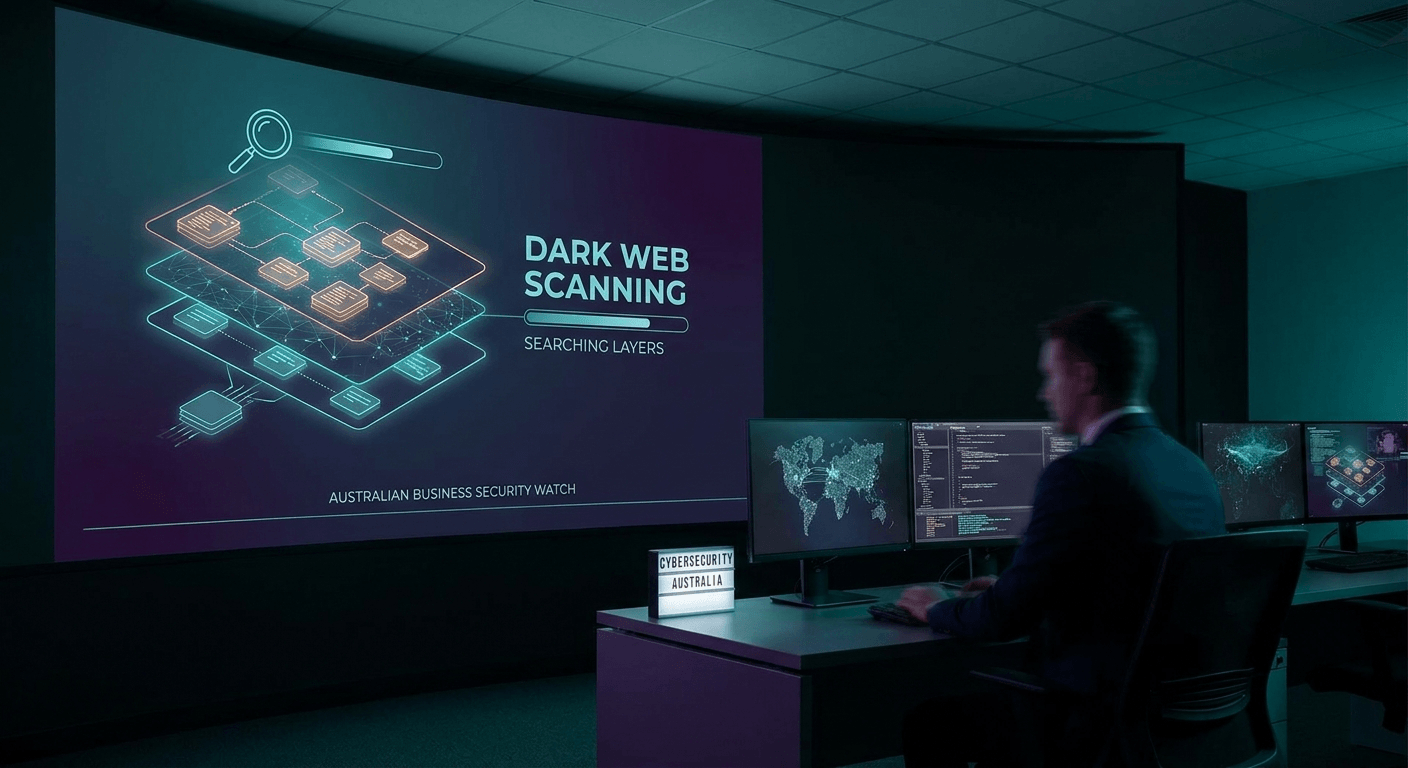
Dark web monitoring scans known breach databases and criminal marketplaces for your business email addresses, passwords, and credentials. If your data appears, you get an alert so you can act before attackers do. For Australian businesses running lean IT teams, it is one of the more practical and low-effort security tools available today.
What Is the Dark Web, Really?
The dark web sounds dramatic, but the concept is straightforward. It is a section of the internet that requires specific software, most commonly the Tor browser, to access. It is not indexed by Google and is not visible in any standard browser.
It has legitimate uses. Journalists, privacy advocates, and people living under authoritarian governments use it to communicate safely. However, it is also where stolen data ends up for sale. Credentials harvested from data breaches, leaked databases, and phishing attacks are regularly posted or sold on dark web forums and marketplaces.
The dark web is less a shadowy underworld and more a grey-market flea market for stolen information. That framing matters because it helps you think clearly about the actual risk to your business.
If you are newer to this topic, it helps to first understand what a cyber attack actually is and how businesses get exposed. Our earlier post in this series, What Is a Cyber Attack and How Does It Affect Australian Businesses?, covers that ground well.
What Does Dark Web Monitoring Actually Do?
Dark web monitoring is an automated scanning service. It continuously searches known breach repositories, paste sites, and dark web forums for your business domain and associated email addresses.
When a match is found, the service alerts you. That alert typically includes:
- Which email address or credential was found
- Which breach or source it came from
- When the breach is believed to have occurred
- What type of data was exposed (password, name, phone number, etc.)
The service does not remove your data from the dark web. Once data is out there, it tends to stay out there. What monitoring gives you is visibility and time to respond before that credential is used against you.
What Dark Web Monitoring Cannot Do
This is worth being clear about. Dark web monitoring is detection, not prevention.
It cannot stop a breach from happening. It cannot remove your data from criminal forums. It cannot tell you exactly who now has your credentials or what they plan to do with them. It also has coverage gaps, because not every stolen dataset ends up in a searchable format.
Think of it like a smoke alarm. It does not prevent a fire, but it gives you the earliest possible warning so you can limit the damage.
Why Old Breaches Are Still a Problem Today
Many business owners assume that a breach from several years ago is no longer relevant. That assumption is incorrect.
Credential databases from major breaches are bought, sold, repackaged, and recirculated for years after the original incident. Attackers use them in what are called credential stuffing attacks, where they try those username and password combinations against email platforms, business applications, and cloud services.
If an employee used the same password across accounts, and that password appeared in a breach three years ago, it may still work today if nobody changed it. Attackers know this and rely on it.
Dark web monitoring catches these older exposures, not just new ones. Many businesses are surprised to find their domain appears in breaches they never knew about.
What to Do When Your Credentials Show Up
Receiving an alert does not mean your business has been compromised yet. It means you have a window to act. Move quickly and follow these steps.
1. Change the Affected Password Immediately
The affected account should have its password changed right away. Use a unique, strong password that has not been used anywhere else. A password manager makes this much easier to manage at scale.
2. Enable Multi-Factor Authentication
If the account does not already have multi-factor authentication enabled, turn it on now. Even if an attacker has the correct password, MFA stops them from getting in without the second factor. This is the single most effective countermeasure after a credential exposure.
3. Notify the Affected Staff Member
The employee whose credentials were found needs to be told. They may have used that password across personal accounts as well. Let them know what was found, what they need to change, and what to watch for.
Drafting that notification does not need to be time-consuming. Microsoft Copilot can help you write a clear, calm staff notification based on the specifics of the alert. Give it the details of the exposure, and ask it to produce a plain-English message the staff member can act on. Copilot can also help you update your incident response plan to include dark web alert handling as a documented step.
4. Check for Suspicious Activity
Review recent login activity on the affected account. Look for logins from unusual locations, times, or devices. If anything looks wrong, treat the account as compromised and escalate accordingly.
5. Document the Incident
Even if nothing went wrong, log the alert and the steps you took. This is good practice and supports any future reporting requirements under Australian privacy laws.
Is Dark Web Monitoring Worth Paying For?
For most Australian SMBs, the honest answer is: yes, but context matters.
As a standalone product, dark web monitoring has limited value. An alert tells you that credentials were exposed. Acting on that alert still requires someone with the knowledge, time, and access to respond correctly. If that person does not exist in your business, the alert sits unread or gets mishandled.
Where dark web monitoring genuinely earns its place is as part of a managed security service. When an MSP is monitoring your environment, a dark web alert feeds into a broader response workflow. The provider can validate the alert, prioritise it against other threats, and walk you through remediation. The monitoring becomes useful because there is someone to act on it.
If you are considering dark web monitoring as an add-on to a larger managed security engagement, it is a worthwhile inclusion. If you are evaluating it as a standalone purchase hoping it will solve a security problem on its own, you will likely be disappointed.
Our managed cybersecurity services include dark web monitoring as part of a layered approach to protecting your business, alongside endpoint protection, identity monitoring, and ongoing threat management.
How MSPs Deliver Dark Web Monitoring
Most reputable managed service providers include dark web monitoring in their security service stack. The tools they use aggregate data from known breach repositories and continuously scan for your domain and email addresses.
When an alert fires, a good MSP does not just forward it to you and move on. They triage it, assess the severity, check whether the credential is still active in your environment, and guide you through the appropriate response. That context is what turns a raw alert into a useful security action.
If your current IT provider is not offering dark web monitoring as part of your service, it is worth asking why and whether it is something they can add.
Summary
Dark web monitoring is not a magic shield and it does not keep your data off criminal forums. What it does is give you early warning when your business credentials appear in breach data, so you can act before an attacker does.
For Australian SMBs, the most practical path is to have dark web monitoring included in a managed security service rather than purchased as a standalone tool. Combined with MFA, strong password practices, and staff awareness, it forms a solid layer in your overall security posture.
If you want to understand what dark web monitoring would look like for your specific environment, book a call with our team and we can walk you through it.
Frequently Asked Questions
What is dark web monitoring for businesses?
Dark web monitoring is a service that scans known breach databases and criminal marketplaces for your business email addresses and credentials. When your data is found, you receive an alert so you can respond before the information is used in an attack.
Does dark web monitoring prevent breaches?
No. Dark web monitoring is a detection tool, not a prevention tool. It identifies when your data has already been exposed and gives you the chance to respond. Prevention requires separate controls such as multi-factor authentication, endpoint protection, and staff training.
How do my credentials end up on the dark web?
Credentials typically end up on the dark web as a result of data breaches at third-party services where your staff have accounts. When a service is breached, the stolen data is often sold or published on dark web forums. Your business may have no direct involvement in the breach at all.
What should I do if my business credentials are found on the dark web?
Change the affected passwords immediately, enable multi-factor authentication on those accounts, notify the relevant staff members, and review recent login activity for suspicious access. Document the incident for your records.
Is dark web monitoring included in managed IT services?
Many managed service providers include dark web monitoring as part of their security offering. If yours does not, it is worth asking whether it can be added. The value of the service is significantly higher when it sits within a broader managed security framework where someone can act on the alerts it generates.
Do small Australian businesses need dark web monitoring?
Small businesses are frequently targeted because their defences are often weaker than larger organisations. Dark web monitoring is particularly useful for businesses with multiple staff members who use business email addresses to register for external services, which describes most Australian SMBs.
managed it support articles
Related Blog Articles
Discover more insights to optimise your business with the latest IT trends and best practices. Stay ahead of the curve by learning how to leverage cutting-edge technology for success. Explore expert advice and valuable guidance to navigate the evolving world of IT solutions