
If you’re a business owner trying to get cybersecurity right, you’ve probably come across both the Essential Eight and ISO 27001. They both aim to reduce cyber risk, but they are built for very different purposes.
Here’s the short answer: most Australian SMBs should start with the Essential Eight. ISO 27001 is for businesses with specific enterprise, contractual, or international obligations. Read on to understand why, and how to decide what’s right for your situation.
What Is the Essential Eight?
The Essential Eight is a cybersecurity framework developed by the Australian Signals Directorate (ASD). It outlines eight mitigation strategies that significantly reduce the risk of the most common cyber attacks targeting Australian businesses and government agencies.
The framework is practical, focused, and designed to be implemented in stages. You can read a full breakdown in our guide to what the Essential Eight is and how it works. The eight strategies are grouped into three maturity levels, ranging from basic hygiene (Maturity Level 1) through to advanced controls (Maturity Level 3). Businesses do not need to implement everything at once.
Who Created It
The Australian Signals Directorate, part of the Australian Government’s intelligence apparatus, developed the Essential Eight specifically for the Australian threat landscape. It is updated regularly to reflect how attacks are evolving.
What It Costs to Implement
Implementation costs vary depending on your starting point. A business with reasonable existing controls might reach Maturity Level 1 across a few months with modest investment. Moving to Maturity Level 2 or 3 requires more time, tooling, and in many cases a managed security partner.
There is no formal certification process. You assess against the framework and improve over time.
What Is ISO 27001?
ISO 27001 is an international standard for information security management systems (ISMS). It was developed by the International Organization for Standardization (ISO) and the International Electrotechnical Commission (IEC).
Unlike the Essential Eight, ISO 27001 is a comprehensive management system standard. It covers not just technical controls but also governance, risk treatment, supplier management, business continuity, and ongoing audit requirements. You can learn more about what ISO 27001 involves in our overview of the ISO 27001 standard.
Who Created It
ISO 27001 is maintained by two global standards bodies: ISO and IEC. It is widely recognised across Europe, Asia, and the United States, which makes it useful for businesses operating in or selling to international markets.
What It Costs to Implement
ISO 27001 certification requires a formal audit by an accredited certification body. The process typically takes 12 to 18 months for most organisations and involves gap analysis, documentation, control implementation, internal audits, and an external certification audit.
Costs can range from tens of thousands of dollars for a small business to significantly more for a larger organisation, depending on scope and complexity.
The Key Differences Between Essential Eight and ISO 27001
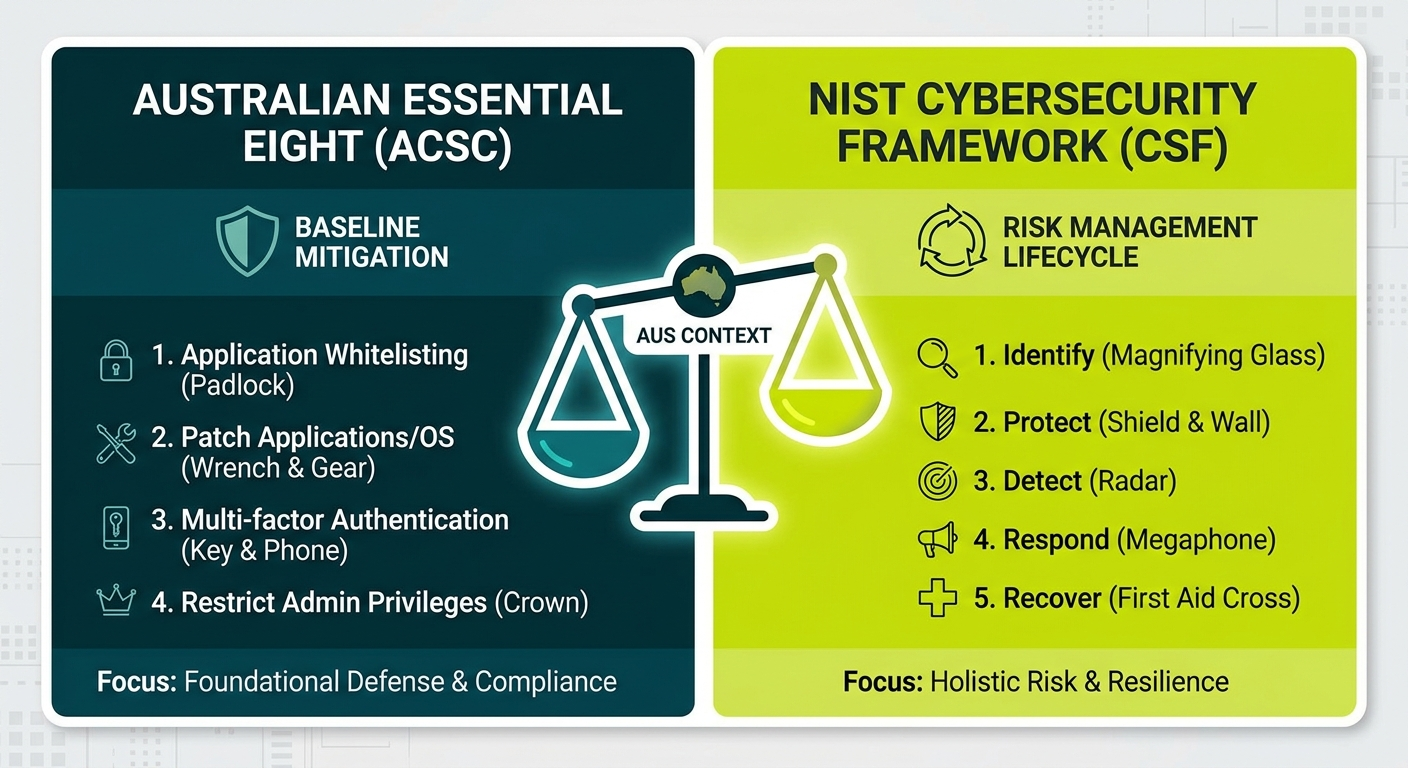
The Essential Eight focuses on specific technical controls that block the most common attack types. ISO 27001 takes a broader view, requiring you to build and maintain an entire management system around information security. Here is how they compare directly:
| Essential Eight | ISO 27001 | |
|---|---|---|
| Created by | Australian Signals Directorate | ISO / IEC |
| Scope | 8 targeted technical controls | Comprehensive ISMS |
| Certification | No formal certification | Yes, third-party audit required |
| Typical cost | Low to moderate | Moderate to high |
| Timeline | Weeks to months | 12 to 18 months or more |
| Best suited for | Australian SMBs | Enterprise, regulated, or international businesses |
When the Essential Eight Is the Right Choice
The Essential Eight is the right starting point for most Australian businesses, particularly those with fewer than 200 staff who are not subject to specific contractual or regulatory requirements.
Choose the Essential Eight if:
- You want to reduce cyber risk quickly and practically
- Your clients or contracts do not require ISO 27001 certification
- You are not subject to international data handling regulations
- You want a structured path to improving security without major overhead
- You are working toward ASD alignment or government supply chain requirements
The Essential Eight delivers meaningful protection without the management overhead of a full ISMS. For most SMBs, that is the right trade-off.
When ISO 27001 Is the Right Choice
ISO 27001 makes sense in specific situations. It is not the default choice for most businesses.
Choose ISO 27001 if:
- Enterprise clients or contracts require it as a condition of doing business
- You handle sensitive data for international clients, particularly in markets with GDPR-adjacent requirements
- You are pursuing a government contract with specific certification requirements
- You are a larger organisation with complex supplier relationships and governance obligations
- You want a globally recognised credential to support market expansion
ISO 27001 is a long-term commitment. It requires ongoing internal audits, annual surveillance audits, and recertification every three years. If you do not have a clear business reason for it, the investment may not be justified.
Can You Do Both?
Yes, and many businesses eventually do. In practice, the Essential Eight often serves as a strong foundation for ISO 27001.
If you implement the Essential Eight well, particularly at Maturity Level 2 or 3, a significant portion of the technical controls required for ISO 27001 are already in place. The additional work for ISO 27001 then focuses more on governance, documentation, and the formal management system layer.
This makes a sensible progression for growing businesses. Get your security fundamentals right with the Essential Eight, then pursue ISO 27001 when a clear business need arises.
The Honest Bottom Line
Most Australian SMBs do not need ISO 27001. The Essential Eight will reduce your risk, improve your security posture, and satisfy most client requirements at a fraction of the cost and effort.
If a specific client, contract, or regulatory obligation requires ISO 27001, then pursue it. Otherwise, start with the Essential Eight and build from there.
Our team provides managed cybersecurity services that include Essential Eight assessments, maturity gap analysis, and ongoing support to help you implement controls at a pace that suits your business.
Book an Essential Eight Assessment today and find out exactly where your business stands.
Frequently Asked Questions
Is the Essential Eight mandatory in Australia?
The Essential Eight is mandatory for non-corporate Commonwealth entities. For private businesses, it is not legally required, but it is increasingly expected by clients and government supply chain partners.
Does ISO 27001 replace the Essential Eight?
No. They serve different purposes. ISO 27001 is a management system standard. The Essential Eight is a set of specific technical controls. Some businesses implement both, with the Essential Eight providing the technical foundation.
How long does it take to implement the Essential Eight?
Timeline depends on your starting point and target maturity level. Reaching Maturity Level 1 across all eight controls may take three to six months for most businesses. Higher maturity levels require more time and investment.
Can a small business get ISO 27001 certified?
Yes, small businesses can pursue ISO 27001 certification. However, the cost and effort involved are significant. Most small businesses are better served by starting with the Essential Eight unless certification is a specific business requirement.
What does an Essential Eight assessment involve?
An assessment reviews your current controls against the ASD framework, identifies gaps, and produces a roadmap for improvement. Otto IT offers Essential Eight assessments as part of our managed cybersecurity services.
managed it support articles
Related Blog Articles
Discover more insights to optimise your business with the latest IT trends and best practices. Stay ahead of the curve by learning how to leverage cutting-edge technology for success. Explore expert advice and valuable guidance to navigate the evolving world of IT solutions